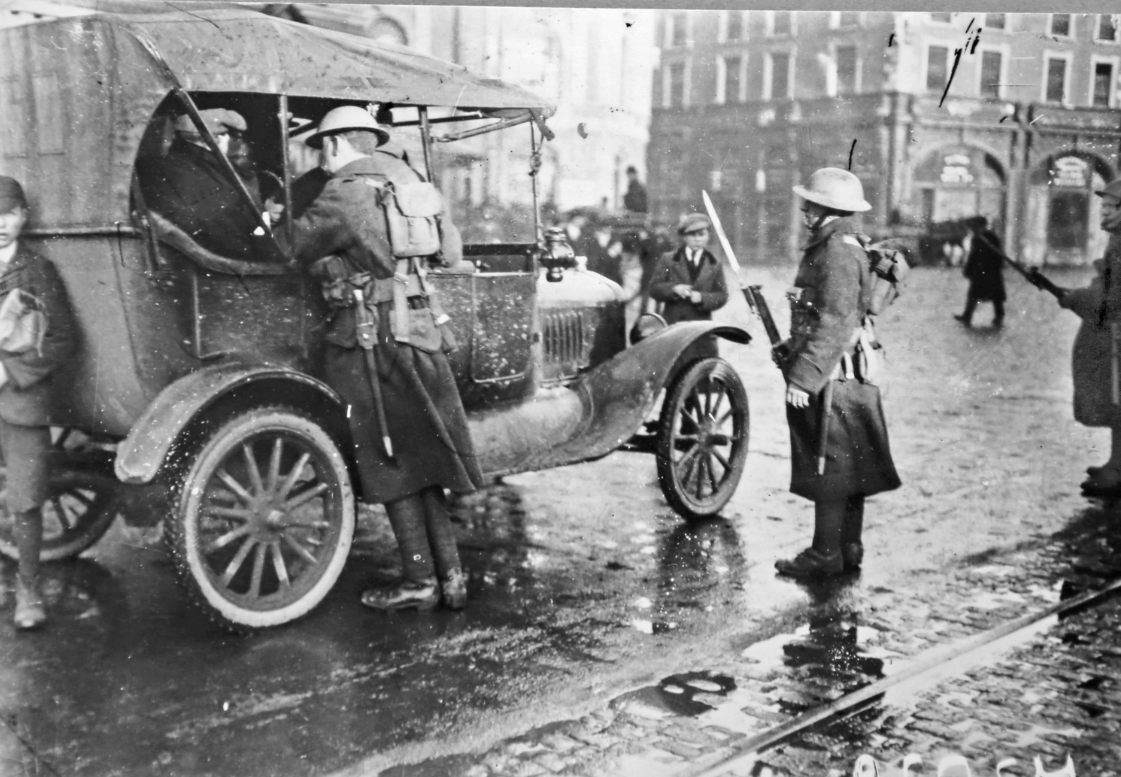
A Closer Look
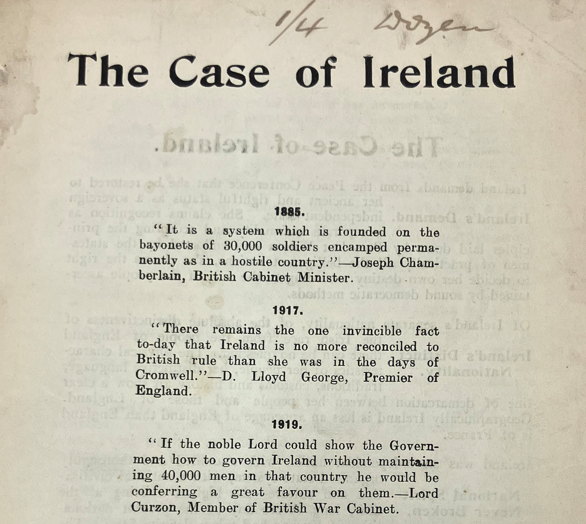
“There is no future for Ireland under the heel of England.” Such was Sinn Fein’s conclusion in a 1919-20 propaganda pamphlet. “The choice,” the author continued, “is one between life and a living death, between progress and decay…There can be no peace in Ireland until the English usurpation is [sic] ended.”[1] As Sinn Fein approached the outbreak of a brutal War for Independence, arguably no other statement best illustrates the transformed aim of the Irish nationalist movement. What had once been the opinion of a radical minority eighty years ago, was now the sentiment of the Irish majority.
In January 1919, as the world reeled from an unforgiving and unprecedented global war, negotiations for peace began. For the next year in what became known as the Peace Conference, the victorious allies redrew borders, expanded their imperial prowess, and cemented the conditions that would lead the world into a second global conflict twenty years later. Yet, for Sinn Fein the Peace Conference brought a distinct hope. Only recently had Sinn Fein been democratically-elected the leaders. Soon after, they declared the Irish Republic and formed an assembly. That same month, the Irish Volunteer Army began its fight against British security forces—a conflict in which Sinn Fein is victorious. But victory would come in two years. In the meantime, Sinn Fein sought allied, particularly American, support.
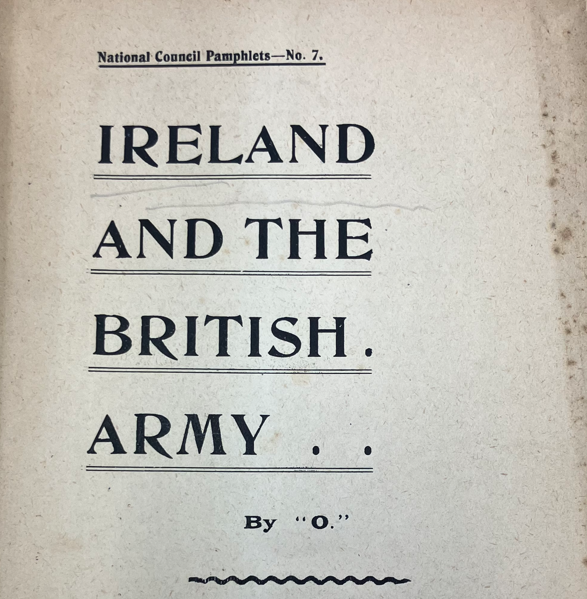
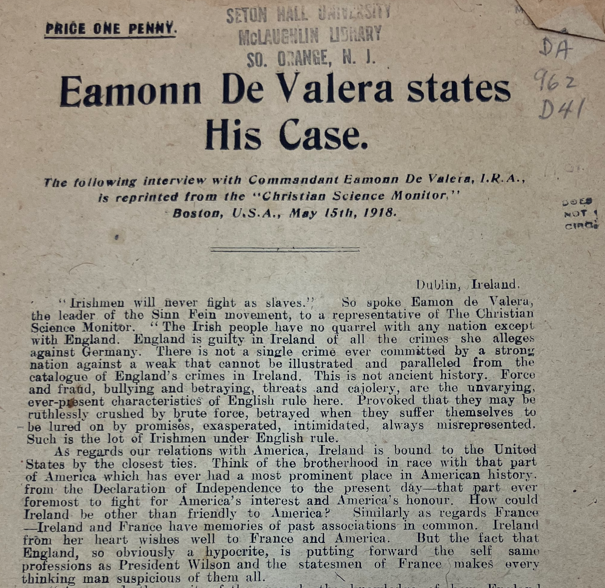
These pamphlets are from a series of propaganda published with the intention to garner public support for Sinn Fein’s militaristic and separatist vision for the national movement. As seen in the latter pamphlets, the intended audience appears to broaden, as Sinn Fein recognizes the potential of European and, especially, American intervention in the aftermath of the First World War.
The first pamphlet, published in 1909, titled “Ireland and the British Army” represents the ideology of the then newly-founded political group, Sinn Fein. The document demonstrates the struggles and beliefs that motivated Irish radicals to seek a different means to independence, culminating in the 1916 Easter Rising. The second pamphlet, “Eamonn De Valera States His Case,” published in 1918, is a transcript of an interview originally published in the Christian Science Monitor and was reprinted later by Sinn Fein. This interview highlights the evolution of the national movement in the aftermath of the ’16 Rising, and the ideology concerning the methods of obtaining independence. Moreover, the pamphlet shows the influence of the First World War on the Irish national movement and the desire for the international recognition of the merits of the movement. Lastly, “The Case of Ireland,” likely published sometime between 1919 and 1920, builds from the previous pamphlet, emphasizing the political value of potential European and American intervention in progressing Sinn Fein’s goal of a complete separation from Great Britain. Moreover, the pamphlet discusses public opinion, highlighting the internal tensions of the Irish people many years before the Civil War (1922-23).
When discussing Sinn Fein’s propaganda during this period, historians have viewed the material primarily as an obfuscation of political and social reality. Rather than simply obscuring reality, I argue that the ideology put forth in these pamphlets can be used to carefully examine the state of Irish political affairs. Where there is an alteration of the truth, there is still truth itself.
[1] Sinn Fein, The Case of Ireland (1919-20), 8.
Bibliography
Dolan, Anne. “Killing and Bloody Sunday, November 1920.” The Historical Journal 49, no. 3 (2006): 789-810.
Fitzpatrick, David. “The Irish in Britain, 1871-1921.” In A New History of Ireland, Volume VI: Ireland Under the Union, II: 1870-1921, edited by W.E. Vaughan, 653-702. Oxford University Press, 2010.
Hopkinson, Michael. “From Treaty to Civil War, 1921-2.” In A New History of Ireland, Volume VII: Ireland Under the Union, II: 1921-84, edited by J.R. Hill, 1-30. Oxford University Press, 2003.
Hopkinson, Michael. “Civil War and Aftermath, 1922-4.” In A New History of Ireland, Volume VII: Ireland Under the Union, II: 1921-84, edited by J.R. Hill, 31-61. Oxford University Press, 2003.
Horne, John. “Ireland and the Wars After the War, 1917-23.” In Towards Commemoration: Ireland in War in Revolution 1912-1923, edited by John Horne and Edward Madigan, 54-64. Royal Irish Academy, 2013.
Kee, Robert. The Green Flag: A History of Irish Nationalism. Penguin Books, 1972.
Lyons, F.S.L. “The New Nationalism, 1916-18.” In A New History of Ireland, Volume VI: Ireland Under the Union, II: 1870-1921, edited by W.E. Vaughan, 224-239. Oxford University Press, 2010.
Lyons, F.S.L. “The War of Independence, 1919-21.” In A New History of Ireland, Volume VI: Ireland Under the Union, II: 1870-1921, edited by W.E. Vaughan, 240-259. Oxford University Press, 2010.
McGarry, Fearghal. “1916 and Irish Republicanism: between Myth and History.” In Towards Commemoration: Ireland in War in Revolution 1912-1923, edited by John Horne and Edward Madigan, 46-53. Royal Irish Academy, 2013.
O’Halpin, Eunan. “Politics and the State, 1922-32.” In A New History of Ireland, Volume VII: Ireland Under the Union, II: 1921-84, edited by J.R. Hill, 86-126. Oxford University Press, 2003.
Rafferty, Oliver P. “The Church and the Easter Rising.” Studies: An Irish Quarterly Review 105, no. 417 (2016): 47-57.