“Eamonn De Valera states His Case.”
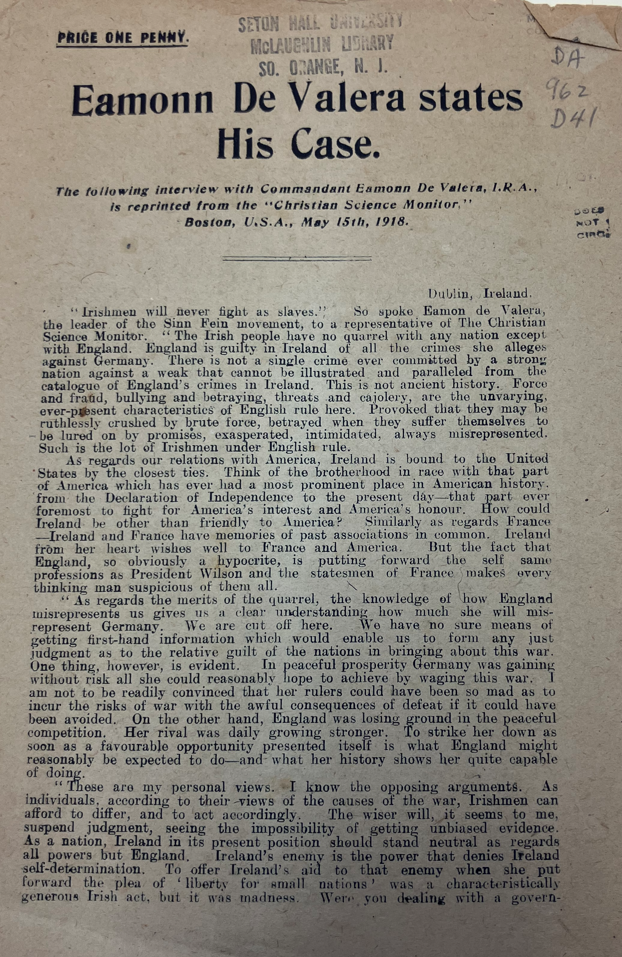
In this brief interview de Valera relates a variety of Sinn Fein’s propaganda points.
He begins the interview by first criticizing England as an oppressive empire that made slaves out of the Irish people. This is a continuous thread through all three of the pamphlets, and is also Sinn Fein’s primary grievance. Second, de Valera likens England to Germany. The First World War is nearing its final months, and President Woodrow Wilson had recently delivered his “Fourteen Points” in Congress. De Valera’s critique calls out England’s hypocrisy as a country that claims to support Wilson’s idea of self-determination, but demands it only of the empires it defeats. England’s understanding of self-determination is limited and tactical. The First World War was controversial in an additional way. In April 1918, the British government attempted to impose compulsory military service onto Ireland. Thousands of Irish men and women gathered in protest. Now known as the “conscription crisis,” the Irish public increasingly viewed the British government as an unflinching oppressor.
While criticizing England, de Valera extends an olive branch to the United States and France, a strategic move of course. Though the First World War has yet to end, its impending peace presented an opportunity for Sinn Fein. Powerful nations would soon negotiate peace terms and redraw borders, and the United States—whose president preached the importance of self-importance—is a potential ally. In highlighting the historic tie between the nations and the contributions of the Irish people, specifically bringing up the Declaration of Independence, de Valera is hoping to endear Americans. Seeking help from Americans and Irish-Americans was a common occurrence for the Irish nationalist movement. Parnell himself did occasionally turn to radical Irish nationalists in the United States.
Nearing the end of the page, de Valera returns to criticizing England, referring to the country as the “enemy” of the Irish nation. He also criticizes the men who volunteered to fight in the First World War for the British, referring to it as a “characteristically generous Irish act, but [to do so] was madness.”
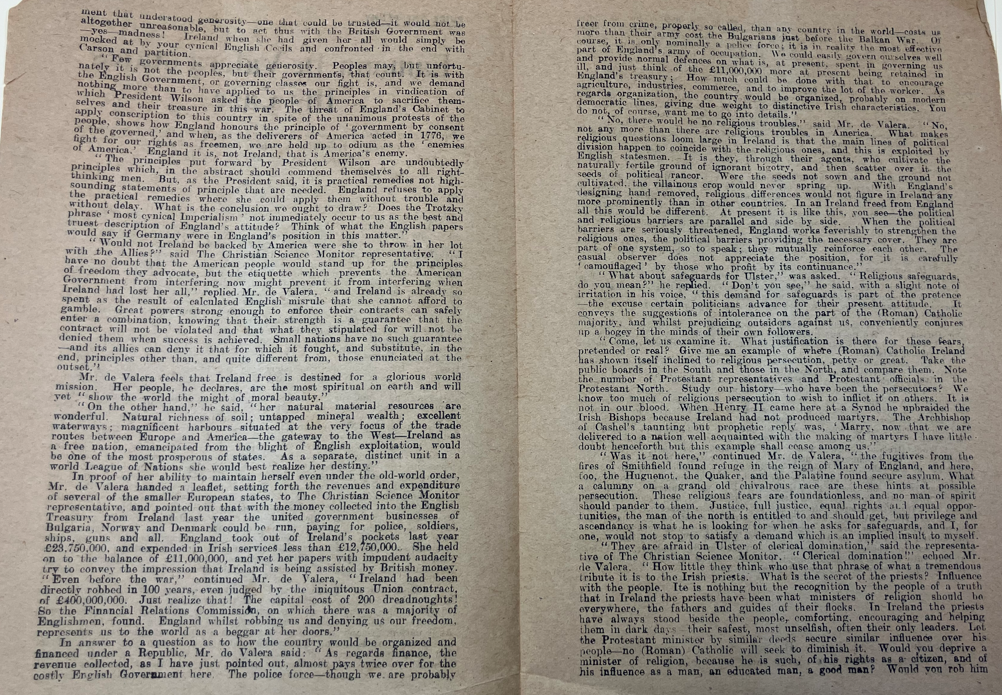
On the following page, de Valera continues his discussion on the ways in which the English government prevents Irish independence. De Valera also makes a pointed jab at the Royal Irish Constabulary, Ireland’s police force, referring to the officers as the “most effective part of England’s army of occupation.” The criticism is harrowing considering that only a few months later would the Irish Republican Army (IRA) wage a War of Independence against said officers. At the heart of de Valera’s economic critique is that the government uses Ireland to fill England’s treasury, rather than using the funds collected to the benefit of the Irish people.
Of course, de Valera must also address the religious aspect of the nationalist movement. He outright claims that the religious tension between Protestants and Catholics was manufactured by the British. Though this is an oversimplification of the nature of the relationship between both groups, but most scholars would agree that any existing tension was made worse by the British. When the interviewer asked about safeguards for Ulster, de Valera countered that the Catholic majority had never persecuted the Protestants. Regardless of whether de Valera’s claim is accurate or not, what he fails to recognize is that Protestants feel vulnerable. It may seem irrational, but the Protestants of Ulster have historically acted on their own interest. They feel a cultural and ideological difference between themselves and the Catholics. De Valera swings into a thorough criticism of Protestants. He refers to them as enemies and colonizers, which certainly would not appeal to any Protestant readers.
De Valera continues his criticism of the men who volunteered to fight on the behalf of the British. But he clarifies that the action was madness because England is not a generous nation. Thus, in volunteering these men are simply putting their lives on the line, only to likely be repaid with a partition—as proposed by Sir Edward Carson, the leader of the Ulster opposition.
De Valera then continues to discuss his primary point, that of self-determination. He says: “[w]e demand nothing more than to have applied to us the principles in vindication of which President Wilson asked the people of America to sacrifice themselves…in this war.” De Valera then discusses the opposition to conscription—which at the time of the interview was an ongoing protest. It is clear that de Valera is taking advantage of Sinn Fein’s growing popularity as result of the conscription crisis. He is blunt; his language is sharp; and he is not afraid to speak on the behalf of the Irish nation.
Like a salesman pitching to investors, de Valera is working to sell Irish independence to the United States. He assures readers that Ireland can be of economic and tactical use to its allies; that the country once independent will sustain itself; and that the land is rich with natural resource. In essence, de Valera hopes to make the task of advocating for Irish independence a more appealing venture. He also clarifies that Ireland, as a self-governing Republic, would be beneficial in Wilson’s League of Nations.
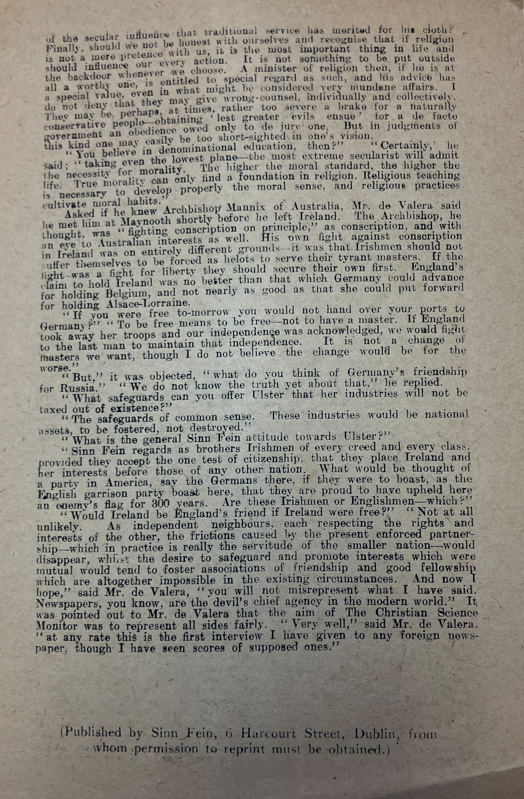
On this final page, de Valera reveals his support for denominational education. As an Irish nationalist, it is no wonder that de Valera envisions an Irish nation, an identity, consolidated with Catholicism. Later in his career as Prime Minister and President of Ireland, de Valera helped create a Gaelic and Catholic Irish identity. He was particularly concerned over the preservation of the Irish language, advocating for more Irish men and women to learn the language.
Here de Valera also clarifies the basis of Irish protest against compulsory military service. He makes it clear that the Irish people oppose serving the British—their occupier—to free others, when they themselves are not free. In response the interviewer asks, “If you were free to-morrow [sic] you would not hand over your ports to Germany?” De Valera clarifies that the Irish desire freedom, not a master. And that if England granted Ireland independence, they would “fight to the last man to maintain that independence.”
“What is the general Sinn Fein attitude towards Ulster?” To this de Valera answers that Sinn Fein regards every Irishmen as brothers, given that they swear an allegiance to the Irish nation.
“Would Ireland be England’s friend if Ireland were free?” De Valera responds that it would not be unlikely, but that that the relationship would only improve if Ireland’s independence were recognized.