“The Case of Ireland”
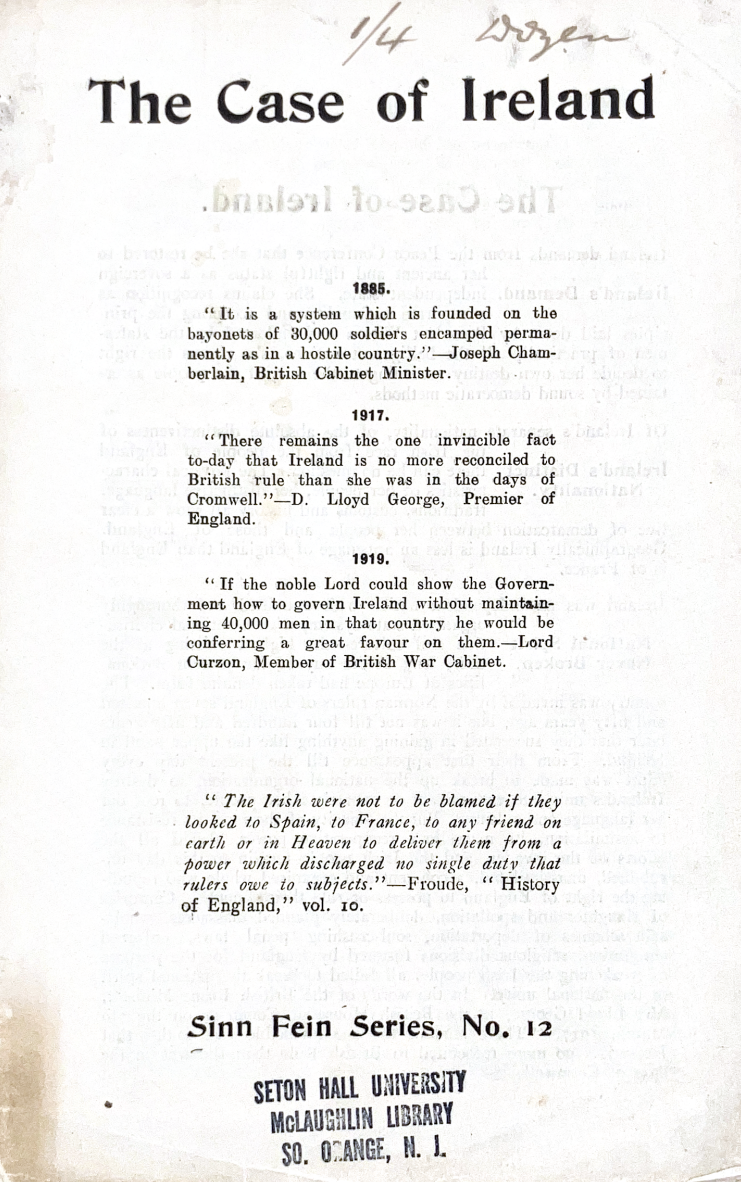
The final document of this set, this pamphlet was published sometime between January 1919 and January 1920. The pamphlet is directed to the Allied powers of the Peace Conference, in which Sinn Fein demands that Ireland be made an independent sovereign republic. As a result, the pamphlet has a more diplomatic tone. The author minimizes the intensity of the Catholic-Protestant tension, and is less venomous toward England. Notably, on this front page, Sinn Fein quotes entirely from British sources; the first three quotations pertaining to prominent politicians—including Lloyd George, who during the Peace Conference, is still Prime Minister of England; and the fourth quotation was pulled from a volume of English History, authored by an English historian.
Notably, this pamphlet was released as Sinn Fein and the Irish Republican Army (IRA) were actively fighting the British during the War of Independence.
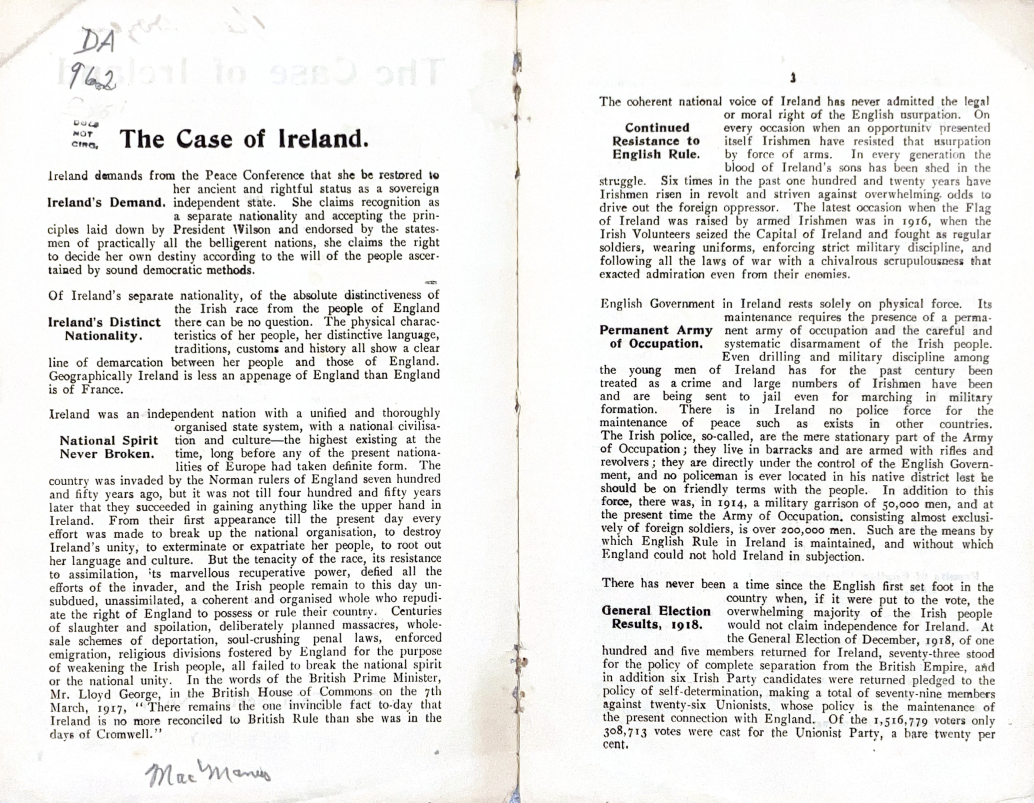
The pamphlet begins by demanding that the nations of the Peace Conference grant Ireland independence. The remainder of the pamphlet, as the title implies, lists the evidence that merits Irish independence.
Firstly, Ireland has a distinct culture, language, and history from England. As President Wilson argued in his “Fourteen Points,” the Irish people have a right to form their own distinct nation. Secondly, Ireland was a distinct independent nation before the Normans invaded. The author argues that since the Norman invasion, Ireland’s distinct identity has been suppressed by England. Here, the author quotes Prime Minister Lloyd George, who said that Ireland remains opposed to British rule.
On that note, the third point is that ireland continues to resist British rule. Here, the author cites that Irishmen have revolted six times in the past one hundred and twenty years. Most recently of course is the 1916 Easter Rising. The author’s description of the Rising is notably inaccurate. The author claims that the men were disciplined, uniformed soldiers, who rebelled in a chivalrous manner. This is a mischaracterization of the rebellion. In fact, the Rising failed because these men were unorganized, had little training, and were unequipped for battle.
The author’s fourth point is that Ireland has been under a permanent army occupation. Here, the author disparages the Irish police force—that is, the Royal Irish Constabulary (RIC)—claiming that the RIC is an extension of the British Army. Furthermore stating that they are well-armed, highly trained, heeded London’s orders, and that the Irish officers of the RIC do not police their native districts. This is a mischaracterization of the truth. Though the RIC did heed the orders of the British government, officers were often beloved in their communities. These men became a part of the local’s lives, even though they were not native to the area. The whole purpose of the RIC was for the officers to integrate themselves, so that they are viewed less like an invading force and more like a police force. Additionally, by 1919 the RIC was poorly trained, poorly armed, and poorly funded. In fact, that is why the IRA was initially successful against the RIC. This is also why the British government later sent the Auxiliaries and the Black and Tans—which by the time of publication, had not yet been sent. These groups were highly armed and consisted of experienced veterans. Comparatively, an overwhelming majority of the RIC did not see any form of conflict. They were mentally unprepared, lacking arms, training, and men.
Finally, the author cites Sinn Fein’s landslide victory in the 1918 General Election, arguing that the majority of the population desires a self-governing Irish Republic.
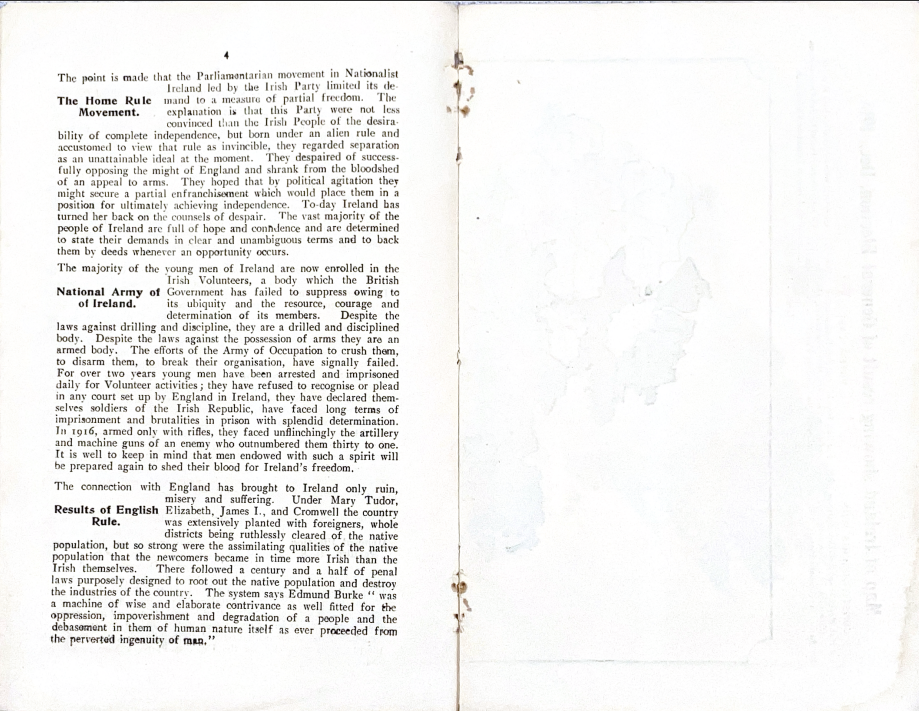
The author’s sixth point explains that Home Rule is no longer an appealing prospect because the majority of the population desires complete independence. By the time of publication, the War of Independence had not yet reached its bloodiest point. Britain had not yet sent reinforcements and the worst of the repeals had not yet taken place. Notably, though, by 1921 with the truce in July, the majority of the population desired an end to the war. The country was unstable and the repeals were brutal. Additionally, it is Sinn Fein who negotiates the 1921 Anglo-Irish Treaty—where Ireland remains a part of the United Kingdom.
The author then claims that a national army had already been formed—that is, the Irish Volunteer Army or the Irish Republican Army (IRA). The Volunteers are spoken of with reverence. However, the IRA was not operating like an army. Using guerrilla tactics and travelling in small, mobile units, the IRA operated less like an army than a terrorist organization. These men killed officers in their homes, as they left mass, and at a train station. Poorly armed, they relied on their raids on RIC barracks to supply themselves with weapons. Once more, the author mischaracterizes the nature of the organization.
Finally, the author states that English rule has brought tragedy and ruin to Ireland.
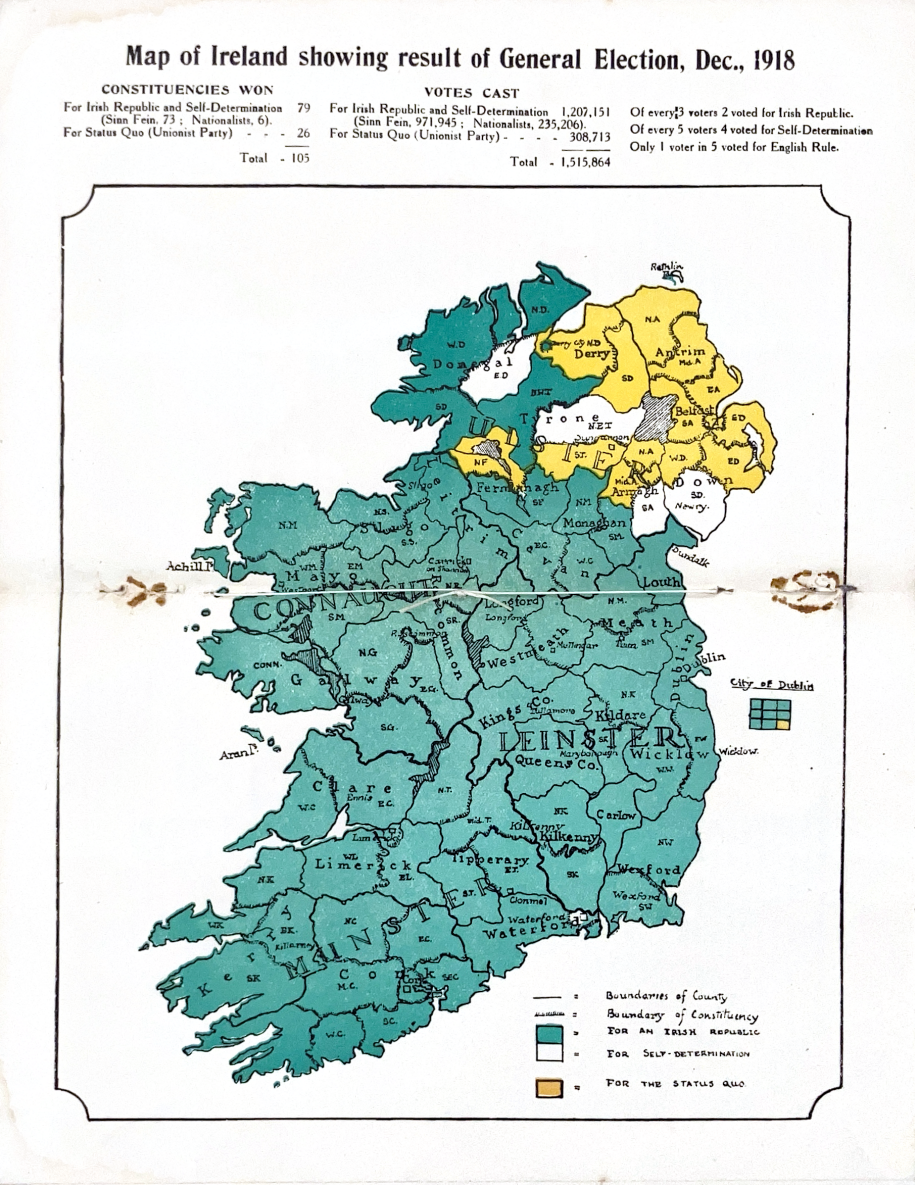
As the title states, a map of the results of the 1918 General Election. Ironically, Sinn Fein declares itself a proponent of self-determination, but when the northern counties of Ulster refuse to join the remainder of Ireland, they cry foul.
The author then cites the 1800 Act of Union in which Ireland was made a part of the United Kingdom. Here, the author notably quotes Gladstone. This is a departure from the antagonism of the first pamphlet, “Ireland and the British Army,” where the author disparaged Gladstone and the British Liberals.
An account of the tragedy of the last century is then given. Notably, the author focuses on the death and emigration of millions of Irishmen and women during the Great Famine. The once quite diplomatic language is much more bitter. The author refers to British rule as a “regime.” A likely unwise choice to garner support from the Allies.
The author then discusses the present-day struggles of English rule, where Irishmen and women are imprisoned, beaten, and killed.
Lastly, the author claims that Ireland, a country rich in natural resources, has been unproductive as a result of English misrule. Notably, in the second pamphlet “Eamonn de Valera states His Case,” de Valera makes the same claim.
The author continues to discuss the wasted potential of Ireland arguing that the country’s industry, commerce, and agriculture have been destroyed. This is not necessarily true because in Ulster, industry is booming, particularly the ship-building industry. Ireland’s agriculture and industry was definitely been impacted by the Great Famine—which Great Britain could have remedied—but it would be inaccurate to ignore Ulster’s economic success. In fact, it is this success that motivated the counties of Ulster to partition Ireland.
The following point, has been an argument in Sinn Fein’s propaganda since its inception. The author argues that Ireland is economically viable and is not dependent on the British. Notably, one of Arthur Griffith’s primary goals was that Ireland be economically self-reliant.
The author then addresses Ulster. Here, he argues that Ulster Unionists are Irish—that is, there is no ethnic or racial distinction between them and the Nationalists. This is an oversimplification of the Ulster position.
Lastly, the author then criticizes how certain reports of the Lloyd George Convention in 1917 were used to argue that the Irish were incapable of ruling themselves.
Most importantly, on this final page, the author discusses the 1918 Conscription Act, and the consequential crisis. It was the conscription crisis that pushed Irishmen to vote Sinn Fein in the 1918 General Election.
Finally, the author argues that so long as Ireland is enslaved by the British government, there will be no peace. This final message feels like a threatening promise. It is an assurance to the Peace Conference that Ireland will continue to be an inconvenience for England.
“It is for those who desire the peace of the world on an enduring basis to end this long chapter of tragedies, this unequal struggle for self-preservation.”