“Ireland and the British Army”
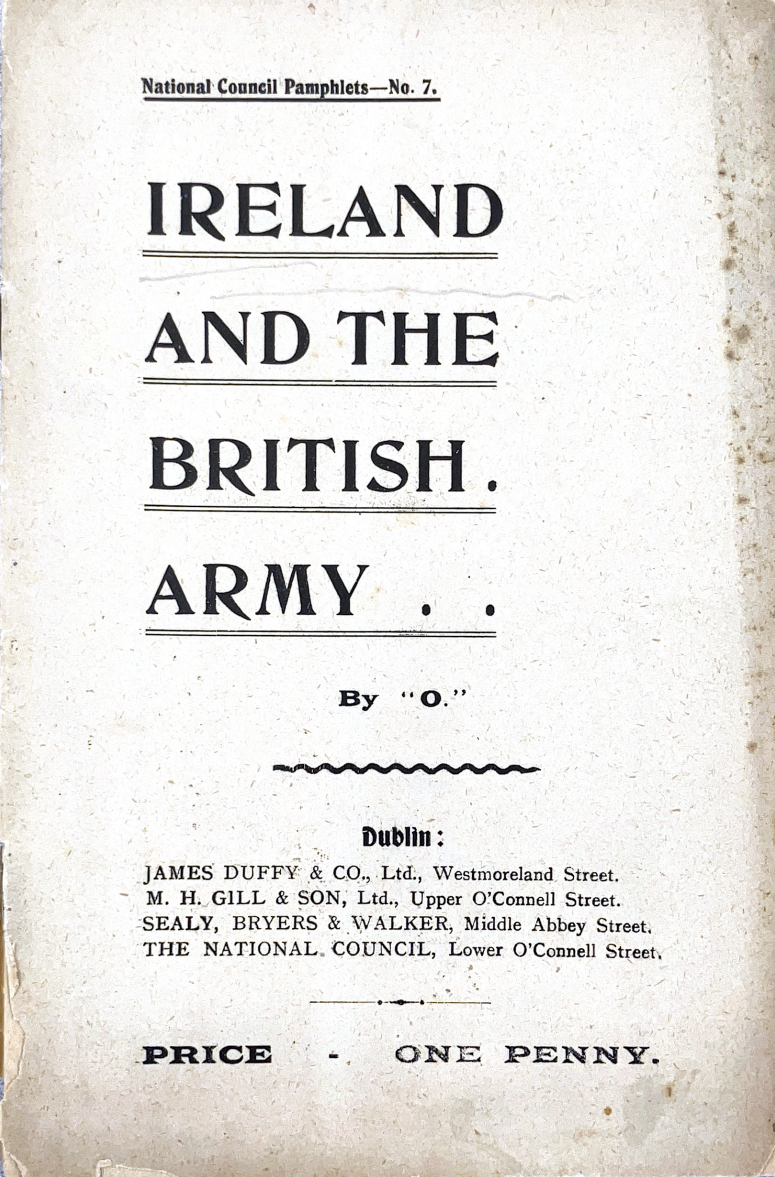
Published in 1909, four years after the formation of Sinn Fein, “Ireland and the British Army” was released as part of the National Council Pamphlets. These pamphlets were released following the 1905 National Council, and were primarily authored by Arthur Griffith. On the front it states that it was authored by “O.” In the previous pamphlets that Griffith had authored, such a pseudonym was not written on the cover. Therefore, it is unlikely he wrote this one. Regardless, these National Council Pamphlets aimed to outline the core beliefs of the party, and the policies they support. The pamphlets emphasize the importance of economic independence, the protection of individual liberties, and the immorality of the British Empire.
This pamphlet is particularly evocative. The writing is bitter and emotionally charged. The author often draws from historic events and a variety of primary sources to make his point. The author also employs hyperbolic language to emphasize the discrimination of the Irish and create a more persuasive argument. Often the author’s bitterness is quite antagonistic and alarming to read.
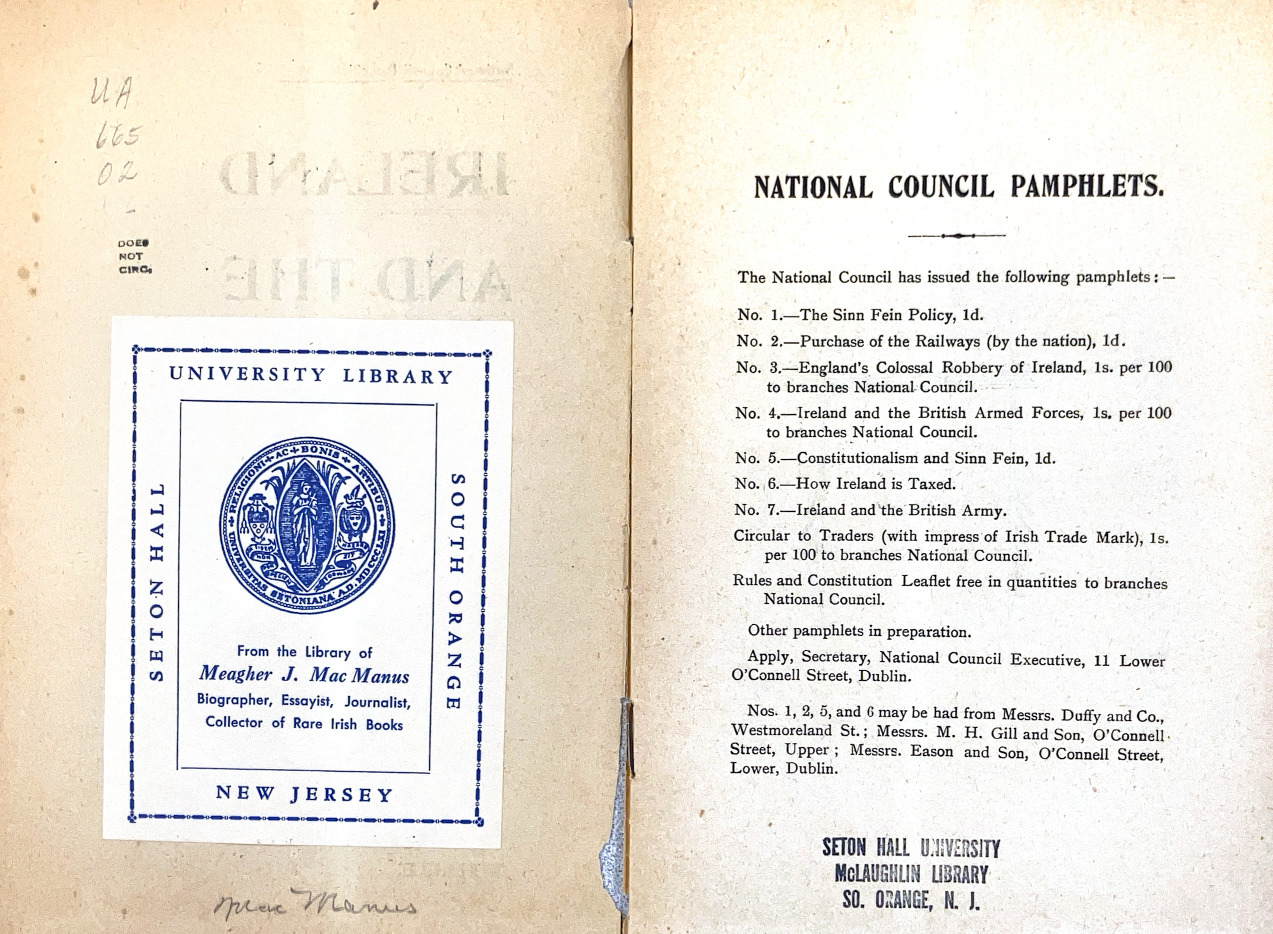
This pamphlet was published as part of a series. In looking at Sinn Fein’s previous pamphlets, one can recognize a theme.
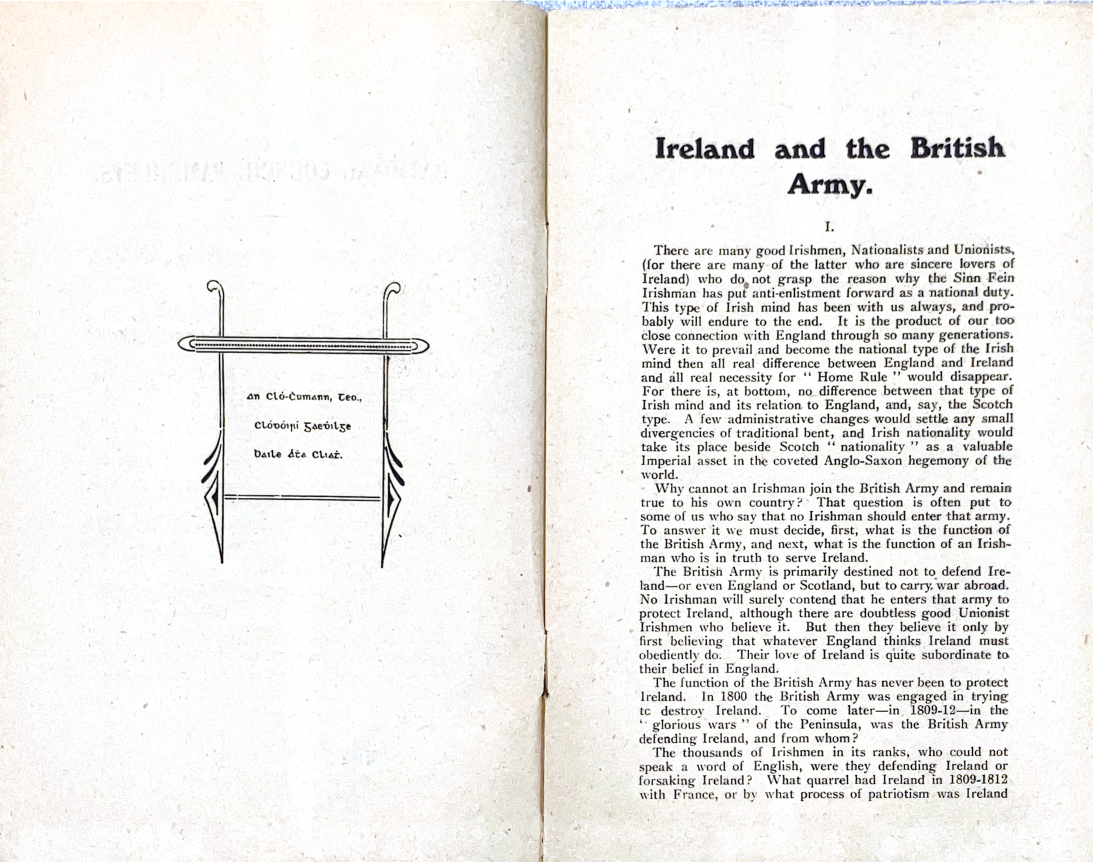
The opening is clear: Sinn Fein is opposed to Irishmen joining the British Army because in doing so, they lose their Irish identity—betraying their country.
“The British Army is primarily destined not to defend Ireland…but to carry war abroad.” This is the basis of Sinn Fein’s opposition to Irish enlistment. Later, with World War I and with the 1918 conscription crisis, many come to consider this to be true.
“In 1800 the British Army was engaged in trying to destroy Ireland.” This refers to the Act of Union passed in 1800, in which the Kingdom of Ireland and Great Britain were united. With this act, Ireland became a part of the United Kingdom.
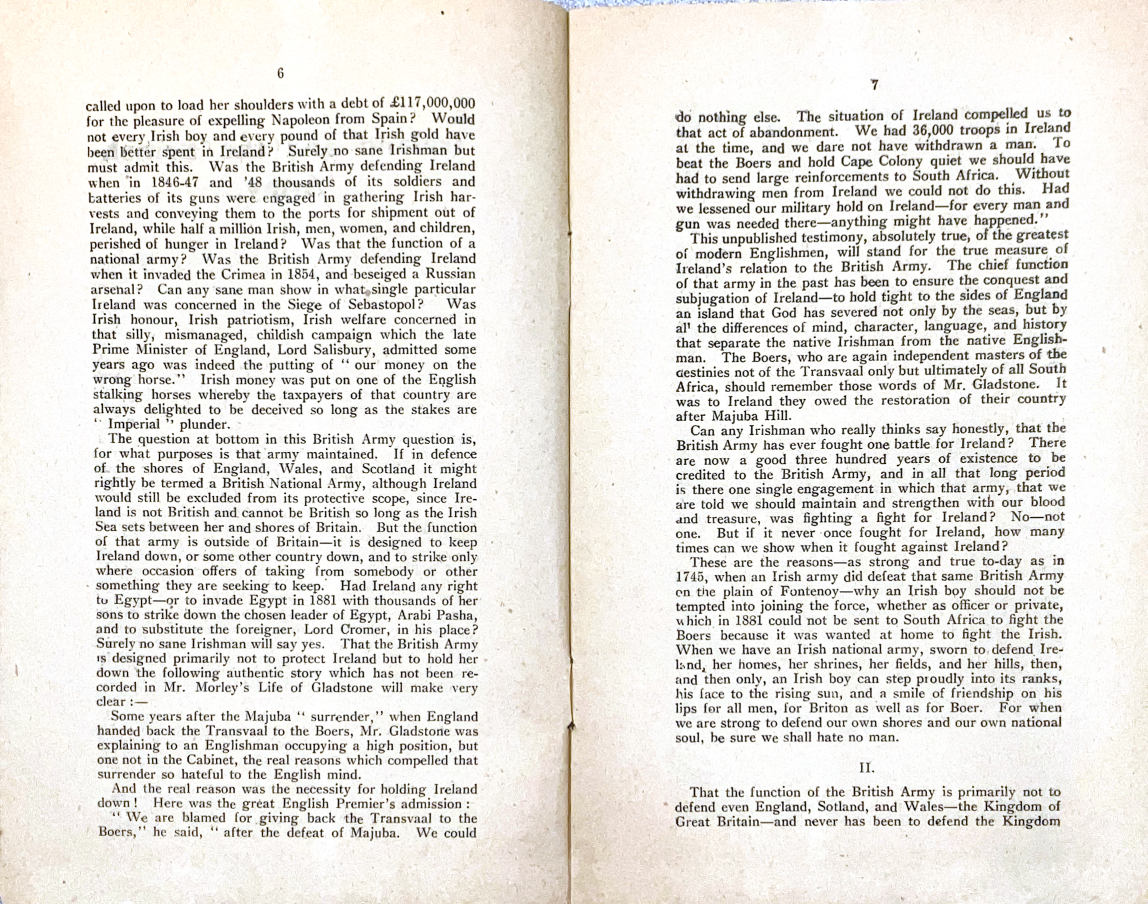
The author then proceeds to list events that demonstrate British misrule, and an apathy for the Irish people. The list consists primarily of the various wars the British Army engaged in that, according to the author, were waged for immoral reasons. The author also lists the Great Famine, alleging that the British Army gathered Irish harvests to feed England, while millions in Ireland starved. Allisions to the Great Famine will continue in Sinn Fein’s messaging. Scholars agree that the severity of the Famine could have easily been relieved had the British government dedicated its resources to do so.
In the last few paragraphs on p. 6, the author attacks William Ewart Gladstone in a story claimed to be true, yet never before told. In the anecdote, Gladstone admits that the reason he sought peace during the First Boer War (1880-81) was to ensure that the “military hold on Ireland” was not lessened. The story attacks Gladstone’s reputation and, in turn, Home Rule. The anecdote is likely untrue, but regardless, in attacking Gladstone—who at the time of publishing has been dead for 15 years—the author also attacks the idea of Anglo-Irish reconciliation. Additionally, the Boer Wars are very important to Sinn Fein. The wars represent British subjugation of the indigenous population in the name of imperialism.
The author then concludes that Ireland must have its own national army; an Irish army for the Irish people. This proposition is directly related to the creation of a national identity.
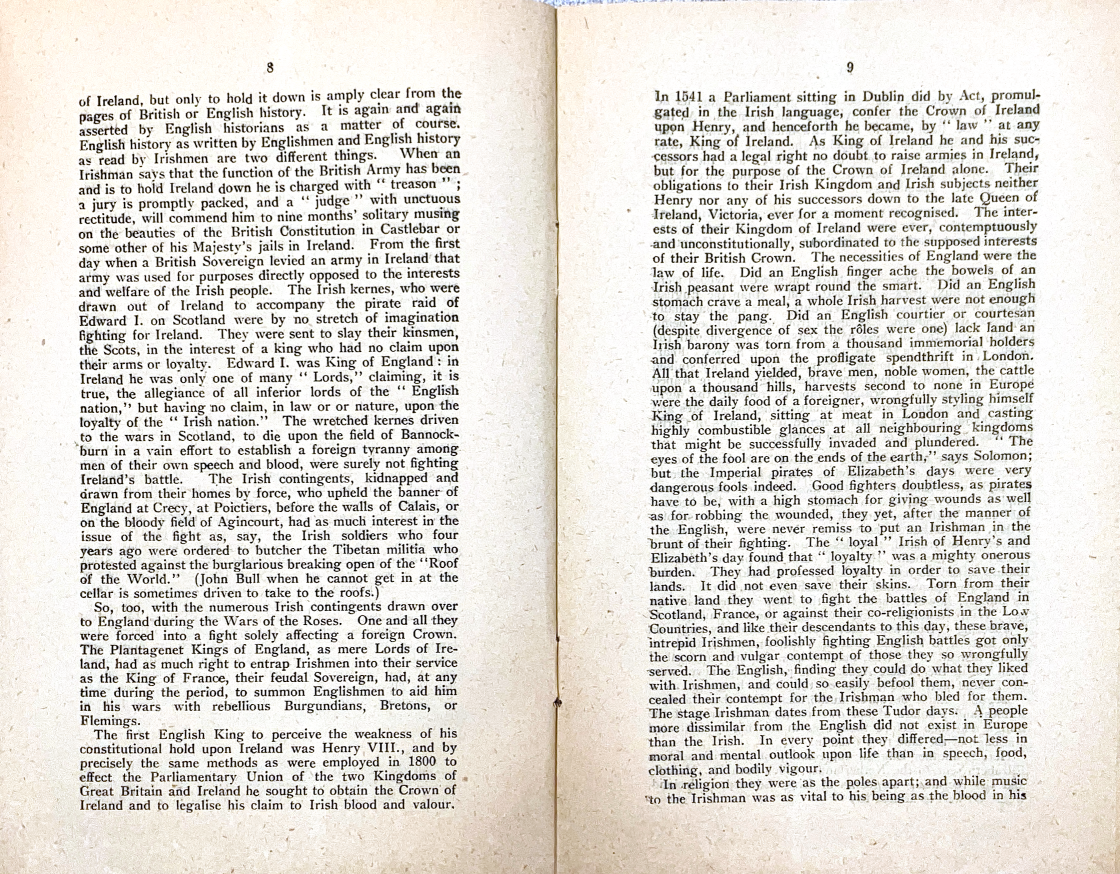
The author repeats that the purpose of the British Army is not to defend Ireland, but to “hold it down.” In citing evidence for this claim, the author turns to English history. “From the first day when a British sovereign levied an army in Ireland,” writes the author, “that army was used for purposes directly opposed to the interests and welfare of the Irish people.” The author then discusses the subjugation of the Scottish and Welsh; specifically referring to English battles against the Scots in which the Irish were forced to fight. Later, during and after the First World War, Sinn Fein will use these examples to argue against Irish enlistment stating that the Irish have been fighting England’s wars for centuries. The author also takes jabs at John Bull, a political caricature that is the national personification of England. “One and all they were forced into a fight solely affecting a foreign Crown.” In 1909, Sinn Fein was getting some traction, but the Irish Parliamentary Party (IPP) had the majority of Irish support. Griffith took a step back during this time when it seemed possible that the IPP would achieve Home Rule. Interestingly, the author of this pamphlet appears to be completely against Home Rule. Home Rule would have created an Irish Parliament that would be tasked with managing domestic affairs, yet under the Westminster Parliament; Ireland would remain a part of the United Kingdom, and the Act of Union would be intact. The author is opposed to the Irish remaining a part of Great Britain, preferring instead the creation of a distinct Irish nation. In nine years, the majority of the Irish people would come to believe the same thing.
“The necessities of England were the law of life. . . Did an English stomach crave a meal, a whole Irish harvest were not enough to stay the pang. . . All that Ireland yielded, brave men, noble women, the cattle upon a thousand hills, harvests second to none in Europe…” Here, the author alludes primarily to the Great Famine. In all three of the pamphlets, the tragedy of the Famine is brought up. The Famine affected families across Ireland. The memory of the starvation, the mass emigration, and loss of lives, stayed with the people. Through this allusion, the author evokes feelings of frustration, anger, and helplessness. That a tragedy so brutal could have been remedied simply through the charity of the British government is appalling—and it also makes an enemy of the English.
The author also states that Ireland does not want to aid England in its plunder and slaughter of the indigenous population. The author cites the Irish of “Henry’s and Elizabeth’s day” who “professed loyalty to save their lands” and lost their lives regardless. The author implies a parallel between the loyal Irish of centuries ago, to the loyal Irish of their present-day. This could refer to the Irish who support Home Rule, but also to the Protestant Irish of the Ulster counties. The author then attempts to dissuade readers from becoming loyal to the English, he writes: “The English finding they could do what they liked with Irishmen, and could so easily befool them, never concealed their contempt for the Irishman who bled for them.” The author then highlights the differences between the Irish and English, concluding that the Irish must have their own nation.
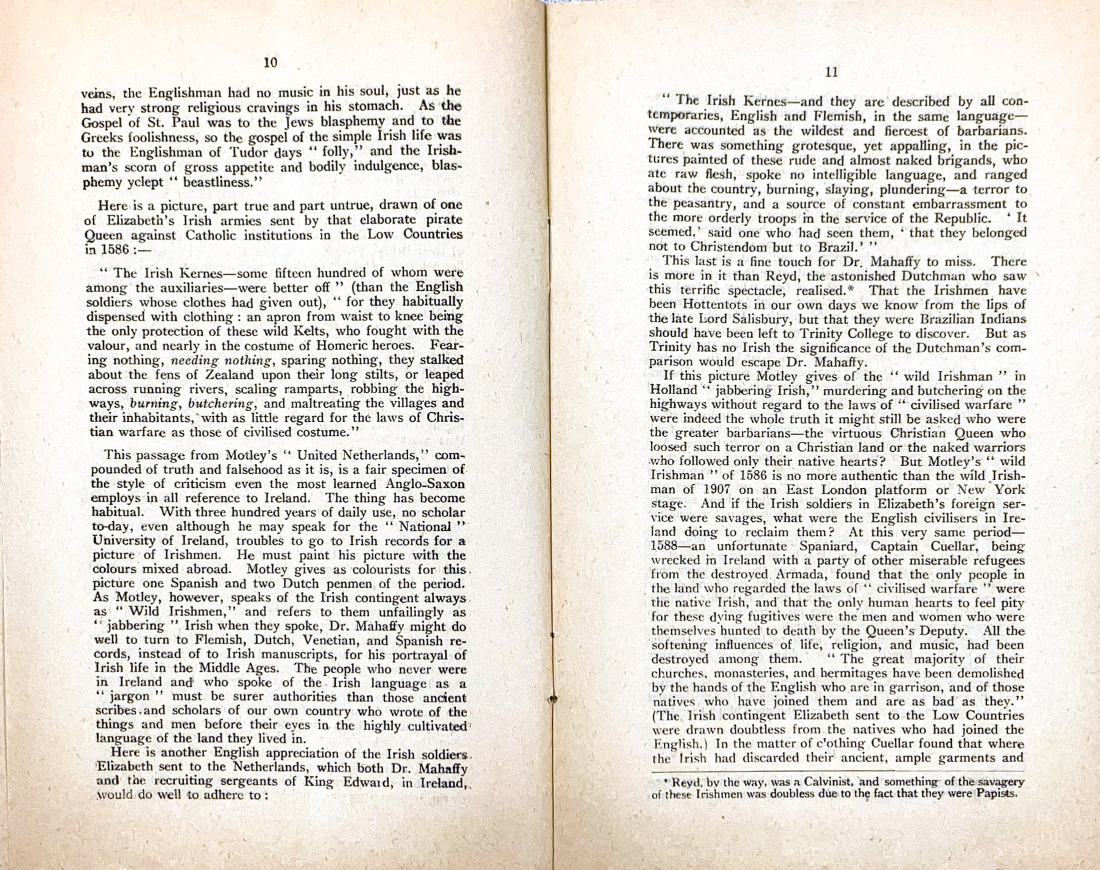
The author then criticizes English histories that portray the Irish people through stereotypes and inaccuracies. When discussing Irish history, these scholars do not drawn on Irish sources. “The people,” he writes, “who never were in Ireland and who spoke of the Irish language as a ‘jargon’ must be surer authorities than those ancient scribes and scholars of our country…” The author’s point on the discrimination Irish speakers face is very important. During the last twenty years of the 19th century, many Iris nationalists, scholars, and artists sought to reclaim Irish culture and celebrate it. In 1893, the Gaelic League was formed—of which Eamon de Valera was an active member of—with the intention to preserve and reclaim the Irish language. Notably, Irish speakers had been discriminated against, oppressed, and ridiculed. Irish scholars sought to have pride in their distinct Irish-ness. What was once a source of shame, was now patriotic.
On p. 11, the author quotes once more from Motley’s United Netherlands which describes the Irish soldiers sent by Queen Elizabeth I to the Netherlands. The Irish are described as wild, barbaric, and cannibalistic. Fanning the flames, a footnote on the page infers that the Irish were likely seen as savages because they were Papists. Clearly the author intends to anger the reader. Who wouldn’t be upset by such an inflammatory account?
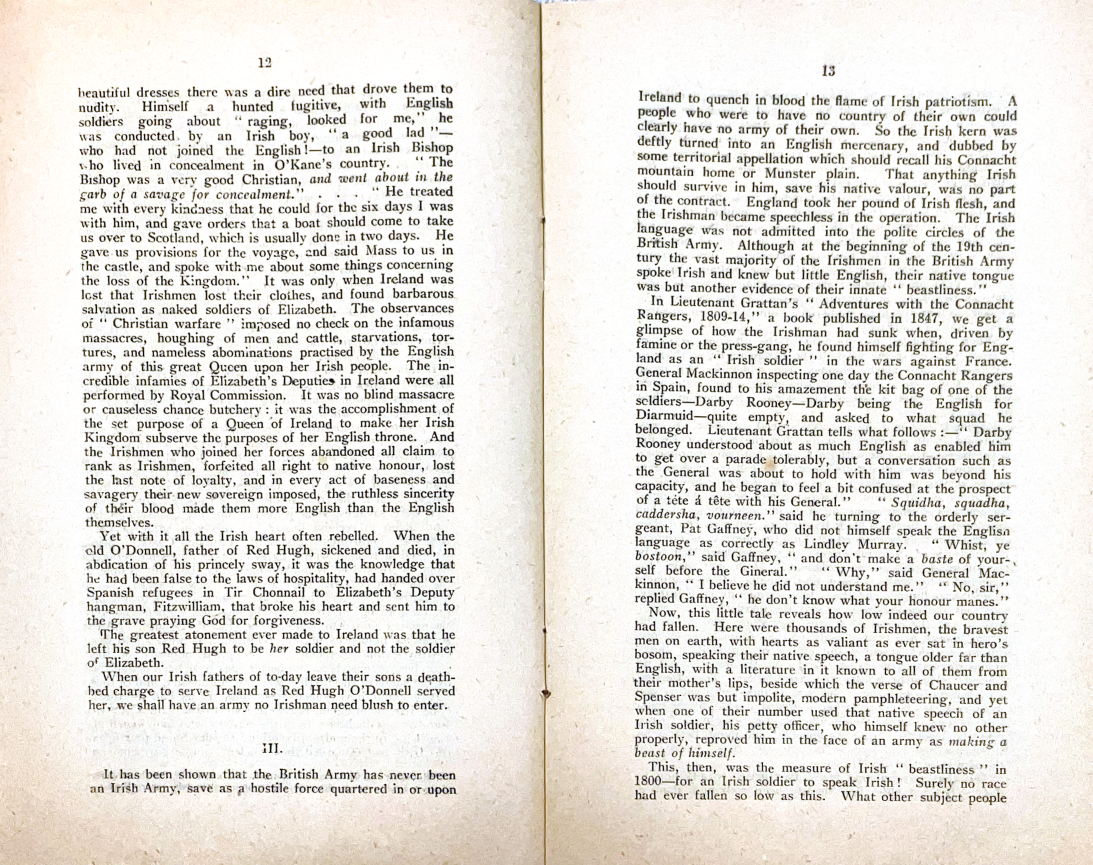
On the previous page and at the top of p. 12, there is a romanticization of the ancient attire of the Irish. Like the nationalist movements of Italy and Germany, Sinn Fein draws on these ancient ties to evoke a sense of patriotism. Continuing with Motley’s account of the Irish fighting for Elizabeth I, the author argues that the account of the Irish as barbarians, shows their loss of humanity. Additionally, he argues that “the Irishmen who joined [Elizabeth’s] forces abandoned all claim to rank as Irishmen…” The author connects a person’s identity, and nationality, to whom they fight in service of. Only a few years later would Sir Edward Carson—an Irish unionist—begin his campaign against Home Rule. Carson’s campaign influenced the 1914 Home Rule Bill, where a temporary exclusion of Ulster was created. Carson’s inflammatory campaign also worsened the relationship between Irish Catholics and Protestants.
The author then continues with his third claim: “the British Army has never been an Irish Army, save as a hostile force quartered in or upon Ireland to quench in blood the flame of Irish patriotism.” That the British government had been apathetic to a moral governance of Ireland is undisputed. Gladstone was an anomaly. The difficulty he faced in getting parliament to consider Home Rule is evidence enough. The author is using various historical examples to highlight the pattern of abuse, and it makes for a compelling read.
Finally, the author returns to the suppression of the Irish language, and the discrimination Irish speakers face. Citing from Lieutenant Grattan’s book, which details the discrimination Irish soldiers faced. A soldier was reproved for speaking Irish, as “making a beast of himself.”
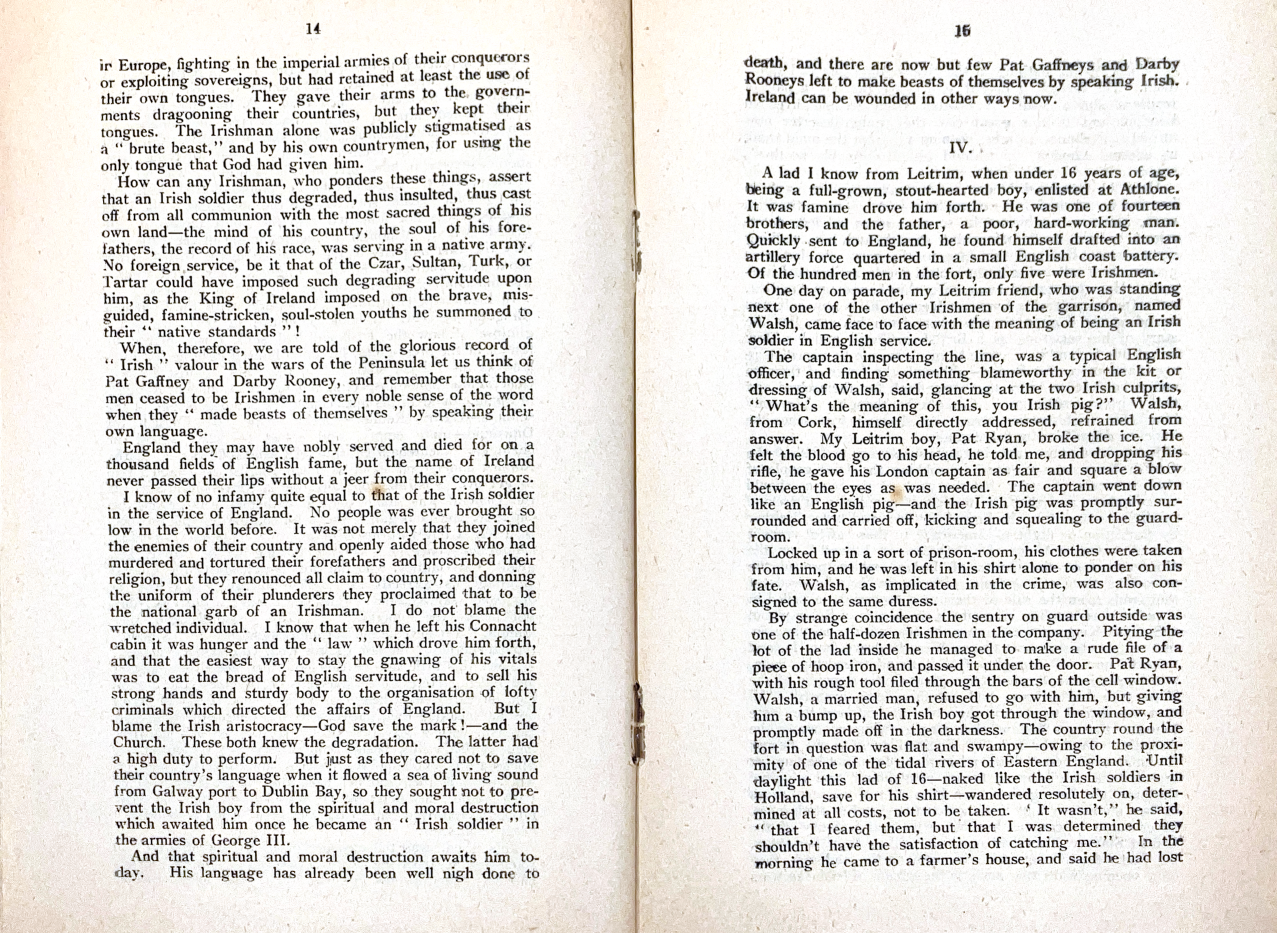
The author often makes use of hyperbolic language. At the top of the fourteenth page, the author claims that the “Irishman alone was publicly stigmatised as a ‘brute beast.’” Later on the page, the author writes, “I know of no infamy quite equal to that of the Iris soldier in he service of England. No people was ever brought to low in the world before.” These hyperbolic statements clearly intend to evoke a sense of frustration toward the level of oppression the Irish face.
On p. 14, the author claims that the suppression of the Irish language severs the Irishman from “the most sacred things of his own land.” The right the author alludes to is that of self-determination, though they did not have the term for it yet. In 1918, inspired by President Wilson, Sinn Fein regularly referred to the right of self-determination in speeches, interviews, and written propaganda.
On p. 15, wrongly numbered 16, the author gives an anecdote. The story is of a young man from Leitrim, named Pat Ryan,—whom the author allegedly knew—who enlisted, driven forth by famine. After the captain called him an “Irish pig,” Pat Ryan delivered a brutal punch. He was stripped of his clothes and locked in a prison-room, which he later escaped from.
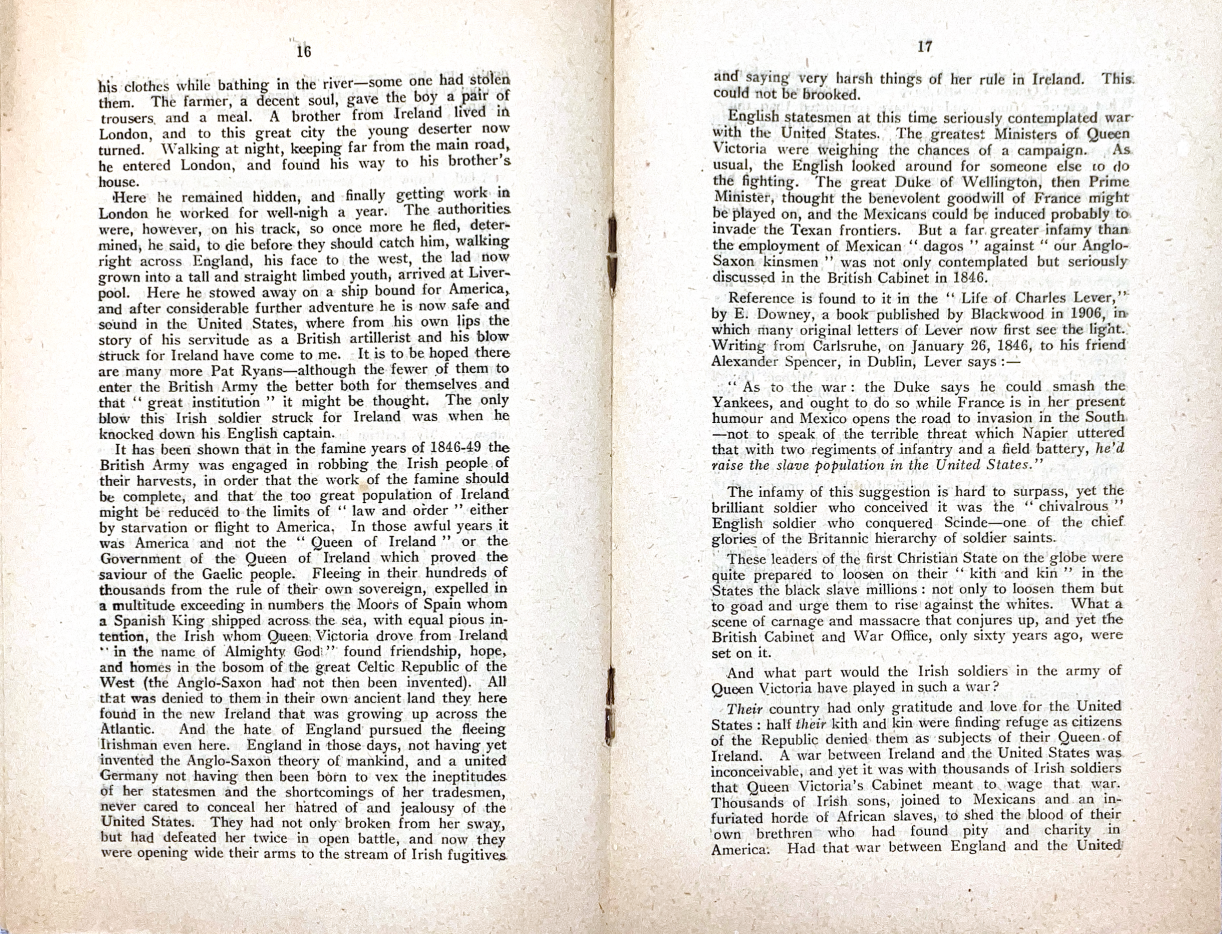
Pat Ryan’s story continues. He comes across a farmer who generously gave the boy clothes and a meal. Pat Ryan then made his way to London to his brother’s house. After a year, he fled on a ship to the United States. The anecdote ties the United States and Ireland together. Later, Sinn Fein makes more explicit connections to the United States. Eamon de Valera is particularly guilty of this.
The author then returns to the Great Famine, alleging that the British Army actively sought to reduce the Irish population “by robbing the Irish people of their harvests.” The author also expresses gratitude towards the United States writing, “In those awful years it was America. . . which proved saviour of the Gaelic people.” The author also refers to the “ancient land” of the Irish, a running them of Irish nationalism.
The author then makes a fascinating claim: England was jealous of the United States. On the following page, p. 17, the author escalates his claim, arguing that “English statesmen at this time seriously contemplated war with the United States.”
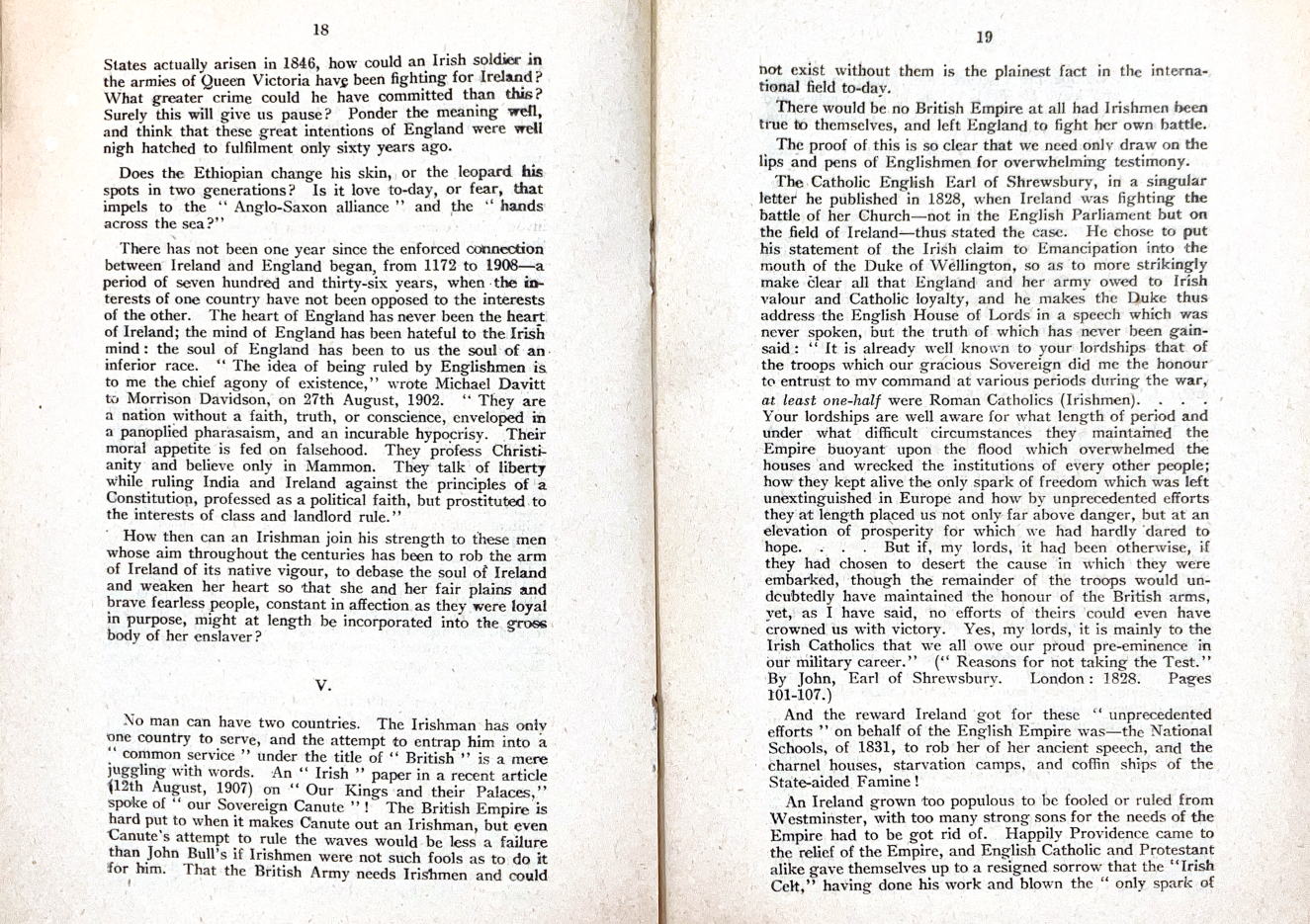
On p. 18, the author emphasizes the centuries that Ireland as been in contact with England, arguing that since 1172 the interests of England have been opposed to the interests of Ireland. Following this line of reasoning, the author poses a question: “How then can an Irishman join his strength to these men whose aim throughout the centuries has been to rob the arm of Ireland of its native vigour. . .?”
The author then makes his next point, that a person can only have once country, and thus one country to serve. Throughout this pamphlet, the author emphasizes the importance of unity in thought and action. The Irish nationalist movement depends on unity to succeed, and for Sinn Fein, an armed force as well. In persuading the Irishman of the evils of British military service and the virtues of an Irish Army, the author romanticizes Irish nationalism. Ultimately, this sense of duty for Ireland, its ancient people, and to remedy their historic discrimination motivates thousands of men to fight in the Irish Volunteer Army (the Irish Republican Army) in 1919.
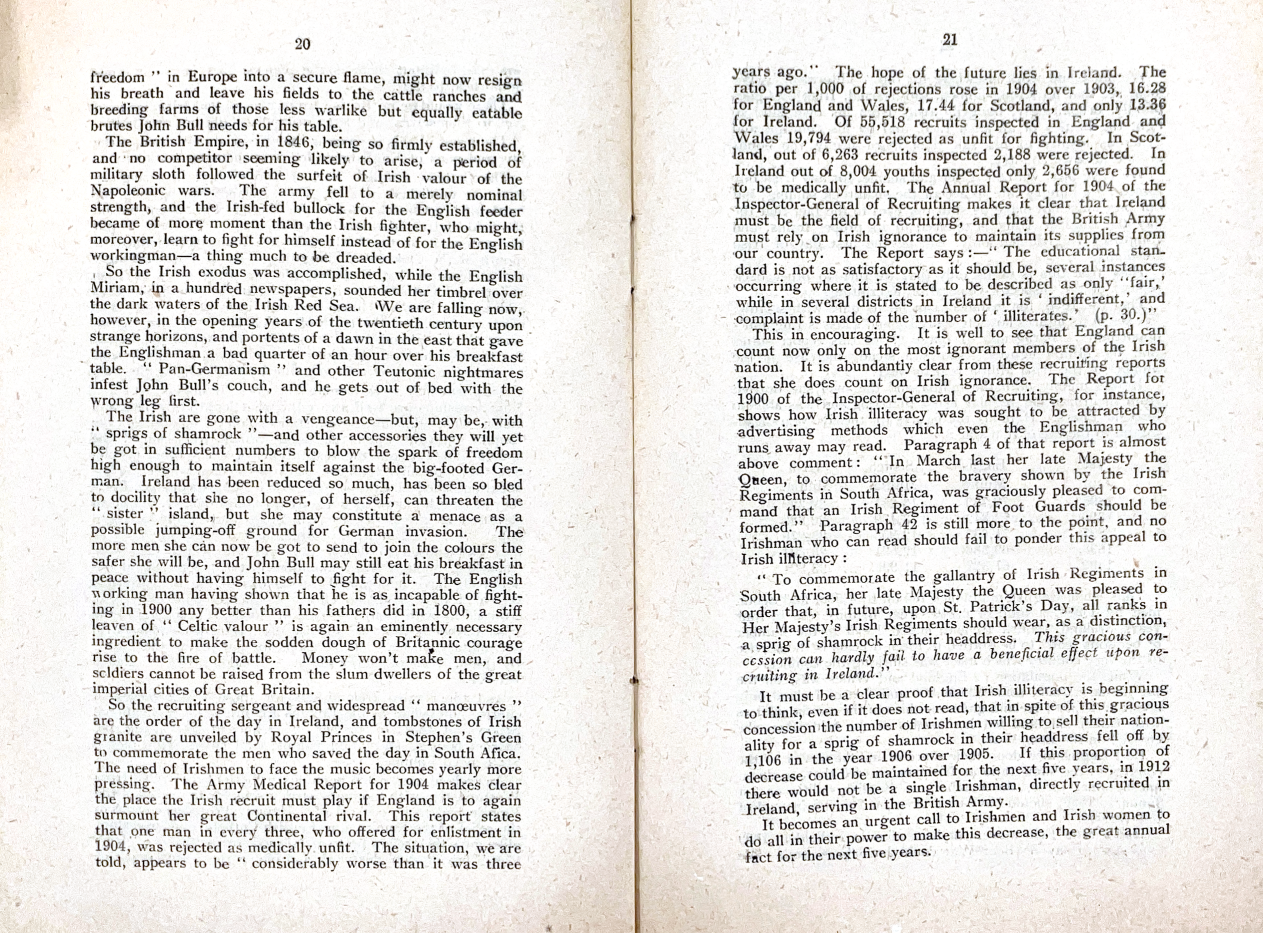
On p. 20, the author make an auspicious claim. He states that England, John Bull, would be pleased if Irishmen were to enlist in the army. This is because if England and Germany go to war, Irishmen can do the dirty work of fighting, while “John bull may still eat his breakfast in peace without having himself to fight for it.” In 1918, with the conscription crisis, this author’s prediction is proven to be true. Irishmen were called for compulsory military service, and Ireland erupted in protests. Ultimately, the conscription crisis was the last straw, and the Irish population elected Sinn Fein in a landslide victory.
Finally, the author calls for the number of Irish enlisters to decrease, arguing that England is recruiting from Ireland to dwindle the population.
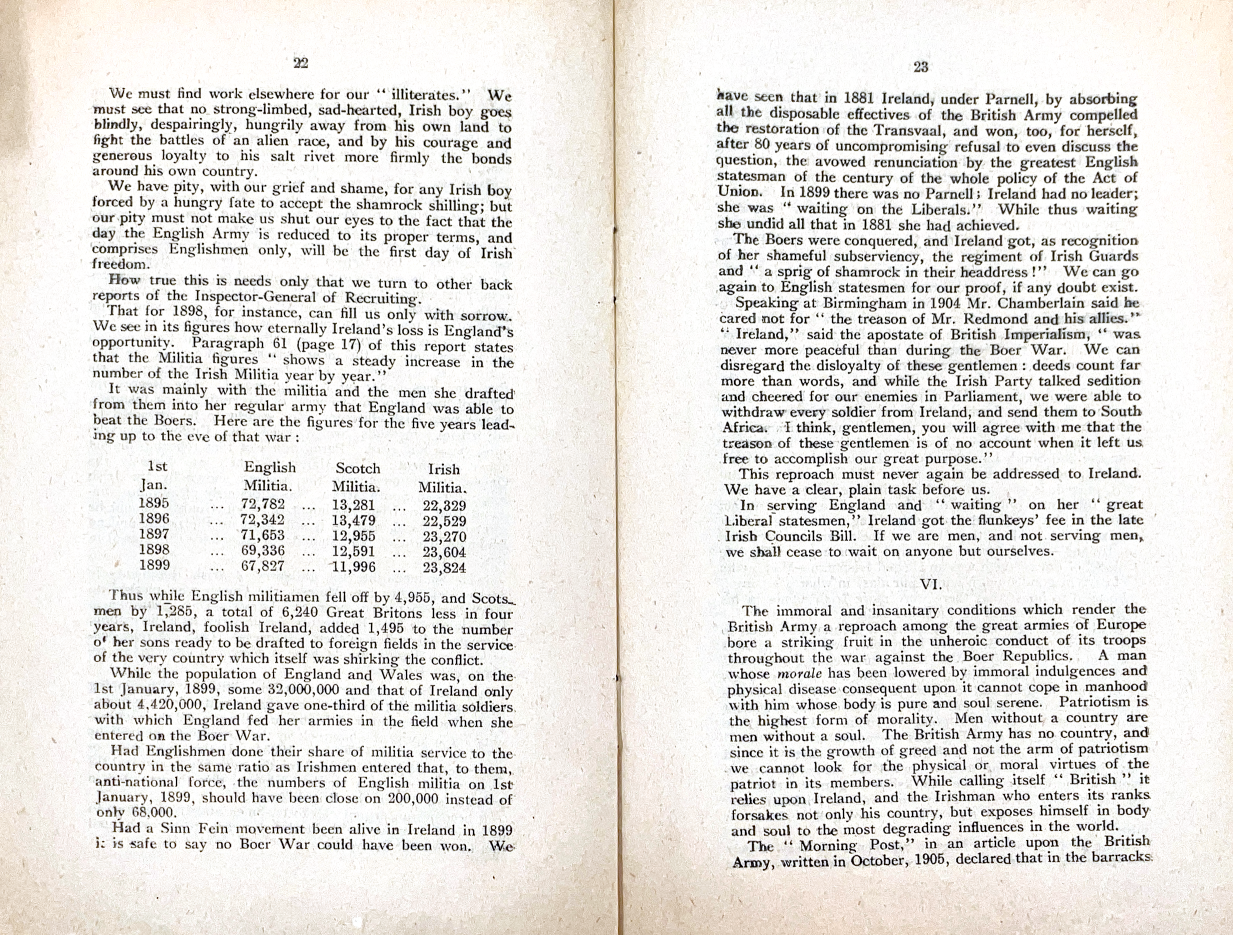
Like the previous page, the author now draws on data to enrich his argument. The author restates that in serving on the British Army, Irish soldiers are directly complicit in advancing Britain’s immoral Empire.
In a blatant inaccuracy, the author credits Parnell with pressuring Great Britain for peace during the First Boer War. Gladstone, the Prime Minister at the time, restored the Transvaal to the Boers, ending the war. The author then disparages the English Liberals. Gladstone himself was a Liberal, yet he empathized with the Irish cause. Parnell was a skilled politician, but his success must also be attributed to Gladstone’s willingness to collaborate. That the author completely disregards Gladstone, instead making an enemy out of all English Liberals is an oversimplification and simply inaccurate. That being said, Gladstone was the one who pushed for the Irish Parliamentary Party (IPP) to get rid of Parnell after his sex scandal; the author may harbor bitterness toward Gladstone as a result.
The author makes his sixth claim: that the British Army is immoral.
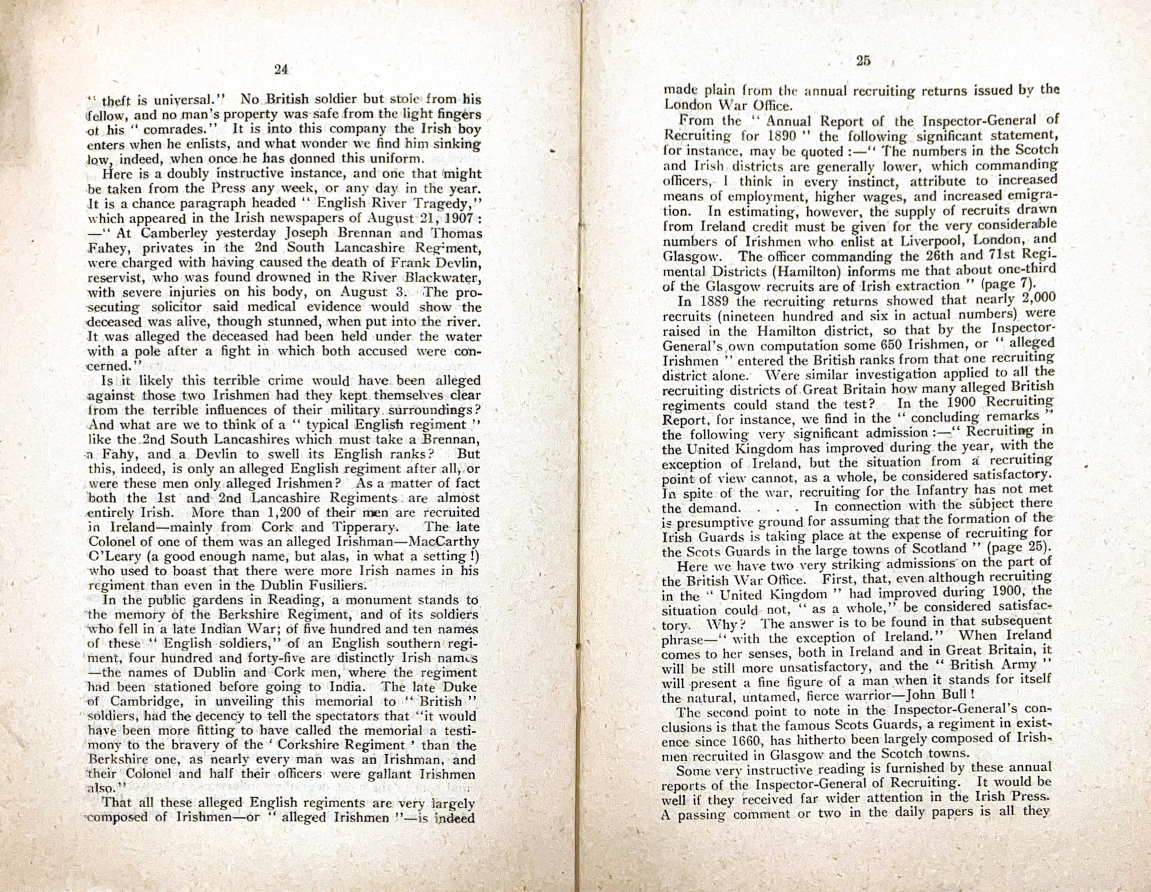
The author argues that British soldiers are immoral thieves, and that when an Irishman serves, he is keeping company with vicious men. In doing so, the Irish soldier is corrupted. The author also expresses concern over the fact that plenty of these regiments are largely composed of Irish soldiers.
After illustrating the mistreatment of Irish soldiers, the subjugation of the Irish people at the hands of the British military, and suppression of the Irish language, when the author reveals that thousands of Irishmen are enlisting, it is shocking. The pamphlet is well-organized and successfully evokes shock from the reader.
At this point, the author has repeated various points already, emphasizing the tragedy of Irish enlistment.
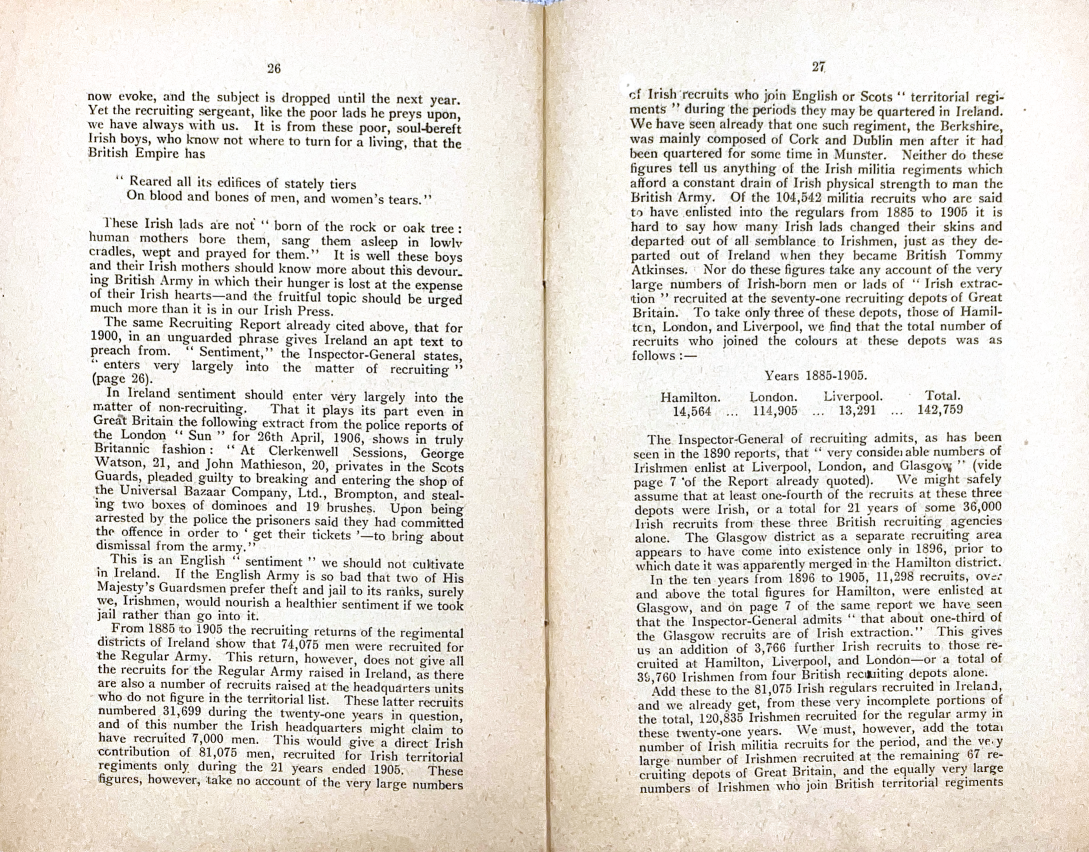
The author often alluded to the poor conditions that push young “Irish boys” to enlist—notably the author here writes “boys,” not “men.” This is also the case with the Royal Irish Constabulary (RIC), the IRA’s opponent during the War of Independence (1919-21). A majority of the officers in the RIC were Irish Catholics from the rural parts of Ireland. These men entered the RIC out of necessity, yet they were brutally murdered and branded as “traitors.” The author here sympathizes with the conditions that pressured these men to enlist, but the argument against their enlisting falls flat. The author argues the immorality of the British Army. However, virtues do not put food on the table nor do they provide sufficient wages to pay the landlord. The author’s argument that the British Army will corrupt these young Irish men and make them accomplices in Britain’s imperial plunder is not sufficiently persuasive to the men who are enlisting. It appears that the author’s aim here is to humiliate Irishmen from enlisting, but his line of reasoning is impractical. The author incorrectly generalizes the all Irish enlisters as loyalists.
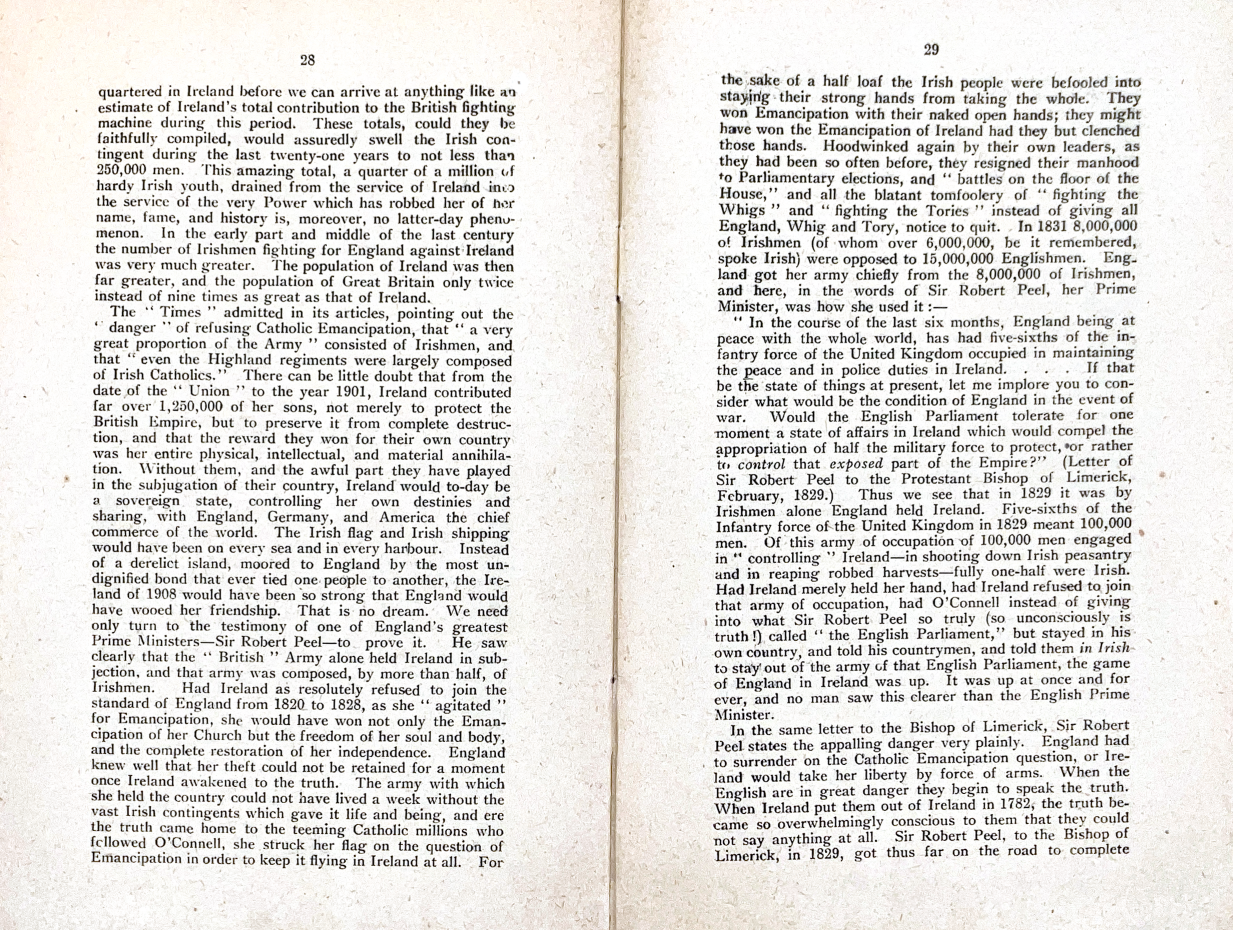
The author once more laments the lack of unity, arguing that if all Irish citizens worked together, Ireland would have already been free from British rule.
Quoting from Sir Robert Peel’s letter to a Protestant Bishop of Limerick, the author finds that in 1831 the British Army occupied Ireland to maintain peace. And that this army consisted of an Irish majority. The brutal murders of the Royal Irish Constabulary (RIC) during the War of Independence (1919-1921), reflected this lasting bitterness. Like the Irish soldiers, RIC officers were condemned as traitors and enemies. These men were murdered leaving mass, in their homes, and at the local pub. The author expresses a complex view of Irish identity and nationality. What does it mean to be Irish? For this author, it is loyalty to one’s land.
In the final pages of the pamphlet, the author emphasizes the merits of Irish strength; that when the country works together, they can successfully pressure England. To do so, the author argues, Irishmen must refuse to fight in the British Army.